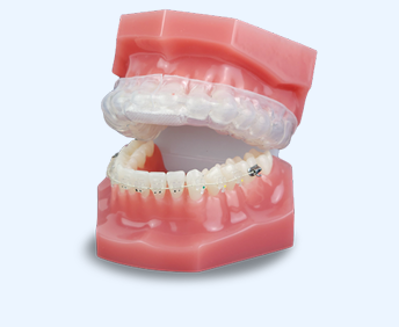
Hard, Soft, or Hard-Soft: What Each Splint Design Actually Does

Ask three dentists what a "splint" is and you may get three answers, because the word covers several different appliances with different properties. Understanding the trade-offs helps you prescribe the right one.

A fully rigid splint gives you an occlusal surface you can equilibrate, index, and adjust precisely. The cost is comfort and seating: any discrepancy in tooth position, contour, or an undercut concentrates into a single pressure point. Tighten it for retention and you risk pressure and difficult seating; loosen it and it sits loose.

A fully soft splint is comfortable and easy to seat, but it's difficult to adjust with any precision and doesn't hold a refined occlusal scheme well.

A hard-soft design — which is what the Talon technique is — puts a resilient, tooth-contacting layer on the inside and a hard acrylic occlusal surface on the outside. The resilient layer adapts intimately to the dentition, absorbs minor variations, and retains without gripping. The hard surface can be equilibrated, indexed, relined, and repaired with conventional acrylic technique.  Read More 

Digital Scans Changed the Records. They Didn't Change the Occlusion

Intraoral scanning has been one of the genuine advances in restorative and appliance dentistry. It removes an entire category of problems: impression distortion, voids, pulls, dimensional change in transit, and errors introduced when a model is poured.

If you have a quality scanner, a digital scan is now the preferred way to capture the arches.

But here's the trap worth naming. A scan captures the teeth. It says nothing about the relationship between the jaws, and nothing about where you want the mandible positioned for therapy.

Scanning both arches gives you two beautifully accurate models — floating in space, with no prescribed relationship to one another. If you don't supply that relationship, someone else decides it for you. Usually that means the case is articulated in centric occlusion and opened arbitrarily, with the posterior-contact consequences we see at delivery.

So the discipline is the same as it always was.

  Read More 

Why Your Splint Hits on the Second Molar at Delivery

You deliver an occlusal splint and the patient closes. To your dismay they close and only hit on their second molars. You use articulating paper and begin to mark, grind and reseat the appliance again and again and again trying to achieve posterior point contact on all of the posteriors all the while praying that you do not end up grinding through your brand-new splint before you achieve a balanced occlusion.

It isn't a fabrication error, and it usually isn't bad luck. It's geometry.

When a case arrives at the laboratory without a construction bite, the models are articulated in centric occlusion and then opened until there's enough room for the prescribed splint thickness. That opening happens on the articulator's hinge — and the hinge sits behind the teeth. Rotating around a posterior hinge doesn't separate the arches evenly. The anterior segment opens more than the posterior segment.

The splint is then built to that geometry.

But the patient doesn't close on the articulator's hinge. They close on their own arc, around their own condylar position. The two arcs don't match. Relative to the patient's real closing path, the appliance is too thick posteriorly — so it contacts first exactly where you keep finding it: the second molar region.

  Read More 

The Cheapest Splint Is Rarely the Least Expensive

Let's be blunt about something the profession doesn't discuss enough: the price on the lab invoice is not the price of the treatment.

A Talon® splint costs more than a conventional acrylic splint or a vacuum-formed dual laminate. That's true. But comparing splints on invoice price alone is comparing the wrong number.

The number that matters is what happens at delivery.

Two things happen because of the Talon material, and the second follows from the first.

There is no internal adjustment. With a hard acrylic splint, the appliance often doesn't go completely to place on the first try. Something blocks full seating — an undercut, a contour, a variation in tooth position — or it binds interproximally and hurts. So before you evaluate anything, you're working on the inside of the appliance: mark the tissue side, relieve the tight area, reseat, mark again, until it's both fully seated and comfortable. That's chair time spent before you've touched the occlusion, and it produces nothing. The resilient Talon surface gives sufficiently to seat around those contact points. It goes to place fully and comfortably on the first try.

  Read More 

How to Run a Team Scanning Day

The intraoral scanner changed what's possible here. Twenty athletes and a box of alginate was a nightmare. Twenty athletes and a scanner is an afternoon.

Here's how to actually do it.

Before you go

Pick the right team first. Your best first target isn't the biggest program in town — it's the one where you already have a relationship. A parent in your practice who coaches. A patient who's an athletic director. Start where you have a door.

Get the coach, not the parents. One conversation with a coach or club director reaches every family at once. Parents individually are thirty conversations; the coach is one.

Decide your fee posture in advance. Team pricing, a package rate, or at-cost as a community investment — all defensible. Decide deliberately, communicate it clearly, and don't improvise on site.

Send consent and health history forms ahead. You need medical history, allergy information, and parental consent for minors before anyone sits down. Chasing paperwork in a gymnasium is how a two-hour event becomes four.

  Read More 

The Treatment Plan Hiding Inside a Mouthguard

Let's talk about money, honestly.Sports Safety

A custom mouthguard is a modest-fee appliance with minimal chair time. Taken alone, it will not transform your production. Many doctors deliberately price it at or near cost precisely because they've understood something about it.

The appliance is not the business. The appliance is the diagnostic entry point.

The clinical prerequisites are the practice economics

Here's what must happen before you can responsibly deliver a custom mouthguard. Read this list as a clinician first and then read it again as a practice owner.

A comprehensive examination. You cannot design protection for a mouth you haven't fully evaluated. Many of these patients — adolescent athletes, adults in recreational leagues — are exactly the demographic that has drifted out of regular care.

Caries treatment completed first. The caries process can be accelerated under a guard worn over untreated lesions, so restorative work has to precede fabrication. This isn't a sales technique; it's a genuine clinical sequencing requirement, and it converts a "we should watch that" into "we need to address this before your son's season starts." Seasons are deadlines. Deadlines close treatment plans that watchful waiting does not.

  Read More 

Your Scan Is the Appliance

Most mouthguard cases now arrive at the laboratory as intraoral scans. Alginate impressions poured in hard stone remain completely acceptable and are processed identically — nothing about your existing workflow has been invalidated.

But if you're scanning, there's one thing you need to know, and it's the thing we see done wrong most often.

These guards are tissue-borne, not tooth-retained

Retention doesn't come from the teeth. It comes from intimate contact between the guard and the soft tissues — the vestibular tissues high above the mucogingival junction, and the palatal tissues.

A scan that captures the dentition beautifully and stops at the gingival margin produces a guard retained by tooth undercuts alone. That is a different appliance than the one that was designed, and it will not perform the way you told the patient it would.

  Read More

Not All Mouthguards Are Equal — But the Old Argument Was Wrong

Here's a conversation that goes badly in dental offices every week.

Parent: "He's got a mouthguard. We got it at the sporting goods store."

Dentist: "Those are worthless. You need a custom one."

Parent: (hears "you wasted your money and I want more of it")

You lost that one before you finished the sentence. Let's fix it, because the correction is also more accurate than what most of us were taught.

The four categories, honestly described

Stock guards are purchased ready-to-wear and require no alteration. There's no retention — they're held in place only by biting down. At impact they typically dislodge. Speech is difficult. This category genuinely should not be recommended by a health professional, and you can say so plainly.

Mouth-formed ("boil and bite") guards are the most prevalent guards in use today. The material is thermoplastic at low temperature so it can be adapted in the athlete's mouth. Because the athlete bites down during forming, occlusal thickness is reduced, and adaptation degrades further with repeated wear. Fit quality depends entirely on the user's technique.

Here's the correction. For years, publications — including ours — stated flatly that boil-and-bite guards should never be recommended by a health professional.    Read More 

What You Can Say About Concussions — and What Will Get You in Trouble

If you learned about mouthguards from continuing education delivered before roughly 2019, some of what you learned is out of date — and at least one thing you may still be telling parents is a regulatory liability.

Here's the good news before the caution: the newer literature gives you a better story than the old one did. You no longer have to defend a speculative biomechanical mechanism. You can point to actual human populations. 

Start with what is settled

Mouthguards reduce dental and orofacial injuries. That evidence is strong.

  • Non-users carry 2.33 times the risk of orofacial injury compared with users (95% CI 1.59–3.44), across twelve cohort trials in a 2019 meta-analysis in Sports Medicine.
  • Dental trauma prevalence was 7.5 to 7.75 percent among mouthguard users versus 48.31 to 59.48 percent among non-users in a 2019 systematic review and meta-analysis in Dental Traumatology — users were 82 to 93 percent less likely to sustain a dentofacial injury.
  • The IADT and the Academy for Sports Dentistry jointly state that mouthguards are effective in preventing dental injuries and are recommended across the many sports carrying increased risk.
  • The European Association for Sports Dentistry identifies custom-made sports mouthguards as the most effective means of preventing these injuries, providing protection and comfort without impairing athletic performance.

Say this category of claim without hedging. It is well supported and the ADA has promoted it for more than fifty years.   Read More 

The One Question You're Not Asking at Recall

There is a question that takes four seconds to ask, that almost no dental practice asks routinely, and that opens more legitimate treatment than any other four seconds in your hygiene appointment.

"Do you play any sports?"  

That's it. That's the question.

Here's why it matters more than it sounds like it should.

Traumatic dental injury has been described as the fifth most prevalent disease condition worldwide, and as being actively neglected by public health organizations. More than one billion living people have sustained a traumatic dental injury. Among twelve-year-olds, the prevalence is 18.1 percent.

Read that last number again with your schedule in mind. Nearly one child in five, before they finish middle school.

And sport is where a great deal of it happens. The National High School Sports-Related Injury Surveillance Study recorded 619,714 injuries during competition in the 2020–2021 school year alone. Of those, 117,820 — 19 percent — were injuries to the head and face. Another 73,818 injuries occurred during practice.

That last figure deserves its own sentence. Injuries happen at practice, not just on game day. A mouthguard worn only at games is a mouthguard worn a fraction of the time it's needed.

   Read More 

Pages