


The One Question You're Not Asking at Recall
There is a question that takes four seconds to ask, that almost no dental practice asks routinely, and that opens more legitimate treatment than any other four seconds in your hygiene appointment.
"Do you play any sports?" 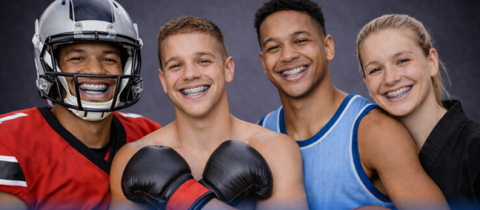
That's it. That's the question.
Here's why it matters more than it sounds like it should.
Traumatic dental injury has been described as the fifth most prevalent disease condition worldwide, and as being actively neglected by public health organizations. More than one billion living people have sustained a traumatic dental injury. Among twelve-year-olds, the prevalence is 18.1 percent.
Read that last number again with your schedule in mind. Nearly one child in five, before they finish middle school.
And sport is where a great deal of it happens. The National High School Sports-Related Injury Surveillance Study recorded 619,714 injuries during competition in the 2020–2021 school year alone. Of those, 117,820 — 19 percent — were injuries to the head and face. Another 73,818 injuries occurred during practice.
That last figure deserves its own sentence. Injuries happen at practice, not just on game day. A mouthguard worn only at games is a mouthguard worn a fraction of the time it's needed.
The part that should bother you
Most of this is preventable. Athletes who don't wear a mouthguard carry 2.33 times the risk of orofacial injury compared with those who do. A systematic review and meta-analysis found dental trauma prevalence of 7.5 to 7.75 percent among mouthguard users versus 48.31 to 59.48 percent among non-users — meaning users were 82 to 93 percent less likely to sustain a dentofacial injury.
Those aren't marketing numbers. They're pooled data from dozens of studies, and they say something uncomfortable: the difference between a protected athlete and an unprotected one is, in most cases, a conversation that never happened in a dental office.
Nobody else is going to have it. The sporting goods store isn't going to have it. The coach isn't going to have it. The parent doesn't know to ask.
What happens after you ask
This is where it gets interesting from a practice standpoint, and we'll spend a full post on it later in this series. But here's the short version.
You cannot properly fabricate a custom mouthguard for a patient with active caries — the caries process can accelerate under a guard worn over untreated lesions. So the mouthguard conversation requires a completed restorative plan.
You cannot responsibly deliver one without evaluating third molars, because the most frequent site of mandibular fracture is the area of the unerupted third molar.
You shouldn't deliver one to a growing patient without an orthodontic assessment — and increased overjet is itself an independent risk factor for traumatic dental injury, which means the patient who most needs protection is often the patient who most needs an orthodontic referral.
And in the mixed dentition, the guard needs reevaluation roughly every six months, which is to say: it's tied to recall.
One question at recall surfaces a comprehensive examination, a restorative plan, a periodontal evaluation, an orthodontic assessment, a third molar evaluation, and a recurring appointment.
Not because you manufactured need. Because the need was already there and nobody had a reason to look.
Start Monday
You don't need new equipment. You don't need a new system. You need one line added to your health history update and one line added to your hygienist's script.
Do you play any sports?
Ask it at every recall. Ask it of adults, too — the weekend basketball league and the jiu-jitsu gym generate the same injuries as the high school field.
Then be ready for the answer. The rest of this series is about what to do with it.
References
Petti S, Andreasen JO, Glendor U, Andersson L. Lancet Glob Health. 2018;6(10):e1070–e1071.
Petti S, Glendor U, Andersson L. Dent Traumatol. 2018;34(2):71–86.
American Academy of Pediatric Dentistry. Policy on prevention of sports-related orofacial injuries. The Reference Manual of Pediatric Dentistry. Chicago: AAPD; 2024:124–129.
Knapik JJ, et al. Sports Med. 2019;49(8):1217–1232.
Fernandes LM, et al. Dent Traumatol. 2019;35(1):54–72.
Arraj GP, Rossi-Fedele G, Doğramacı EJ. Dent Traumatol. 2019;35(4–5):217–232.
Written by Dr. Rob Veis, DDS. President of SML