


Your Scan Is the Appliance
Most mouthguard cases now arrive at the laboratory as intraoral scans. Alginate impressions poured in hard stone remain completely acceptable and are processed identically — nothing about your existing workflow has been invalidated.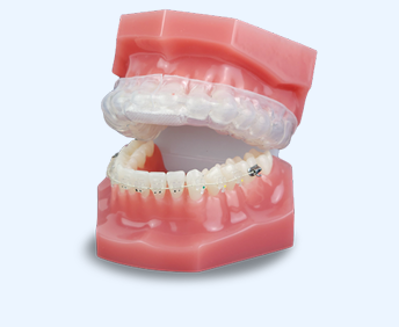
But if you're scanning, there's one thing you need to know, and it's the thing we see done wrong most often.
These guards are tissue-borne, not tooth-retained
Retention doesn't come from the teeth. It comes from intimate contact between the guard and the soft tissues — the vestibular tissues high above the mucogingival junction, and the palatal tissues.
A scan that captures the dentition beautifully and stops at the gingival margin produces a guard retained by tooth undercuts alone. That is a different appliance than the one that was designed, and it will not perform the way you told the patient it would.
The scan protocol:
1. Full arch, posteriorly to at least the distal of the first molars.
2. High into the buccal and labial vestibule, well past the mucogingival junction. Published design guidance calls for labial extension, conically tapered, as far as the vestibular sulcus permits — or to within about 2 mm of the vestibular reflection.
3. Capture the palate. Don't stop at the palatal gingival margin.
4. The opposing arch.
5. Retract adequately. Tissue that isn't exposed can't be captured. Tissue that isn't captured can't be used for retention.
Here's why this matters beyond fit: a guard whose retention doesn't depend on tooth position is, by definition, a guard that keeps working while the teeth are moving. Hold that thought — it's the entire basis of the orthodontic post later in this series.
The construction bite didn't go away
Digital didn't eliminate it. Whenever you can take one, take one.
This isn't a legacy step nobody got around to retiring. The 2025 EA4SD position statement specifies that a custom sport mouthguard should be articulated on the basis of a dentist-made bite registration and adjusted to the opposing dentition in a balanced, preferably myocentric position.
The construction bite controls two things we cannot infer from scans of the arches alone:
- Vertical dimension — the height at which the guard is built.
- Anteroposterior relationship — where the mandible sits relative to the maxilla.
Both are design inputs, not incidental details. A guard built to a registered bite lets the opposing arch intercuspate into a defined, comfortable position rather than into whatever surface happened to result.
The design rationale for registering that relationship is to seat the mandible where it doesn't encourage posterior and superior condylar displacement on impact. That's sound clinical reasoning and it's why the step exists. State it as reasoning — it has not been demonstrated as a protective outcome in a clinical population, and it shouldn't be marketed as one.
If a bite can't be obtained, note that on the prescription so we know the vertical was set by default rather than by design.
Why this is good news for your schedule
The scan is fast. Fast enough that a team scanning day is genuinely practical in a way alginate impressions never were — twenty athletes in a school gymnasium is now a logistics problem, not a fantasy.
That single workflow change is what makes everything in the economics post possible.
References
Avgerinos S, et al. Dent Traumatol. 2025;41(3):246–251. doi:10.1111/edt.13019
Roberts HR. Dent Traumatol. 2023;39(2):101–108. doi:10.1111/edt.12809
Note: published design guidance recommends minimal palatal extension in the finished guard. The Intact® design derives retention from palatal tissue contact and departs from that recommendation — but whichever extension is ultimately designed, the palate must be present in the scan.
Written by Dr. Rob Veis, DDS. President of SML